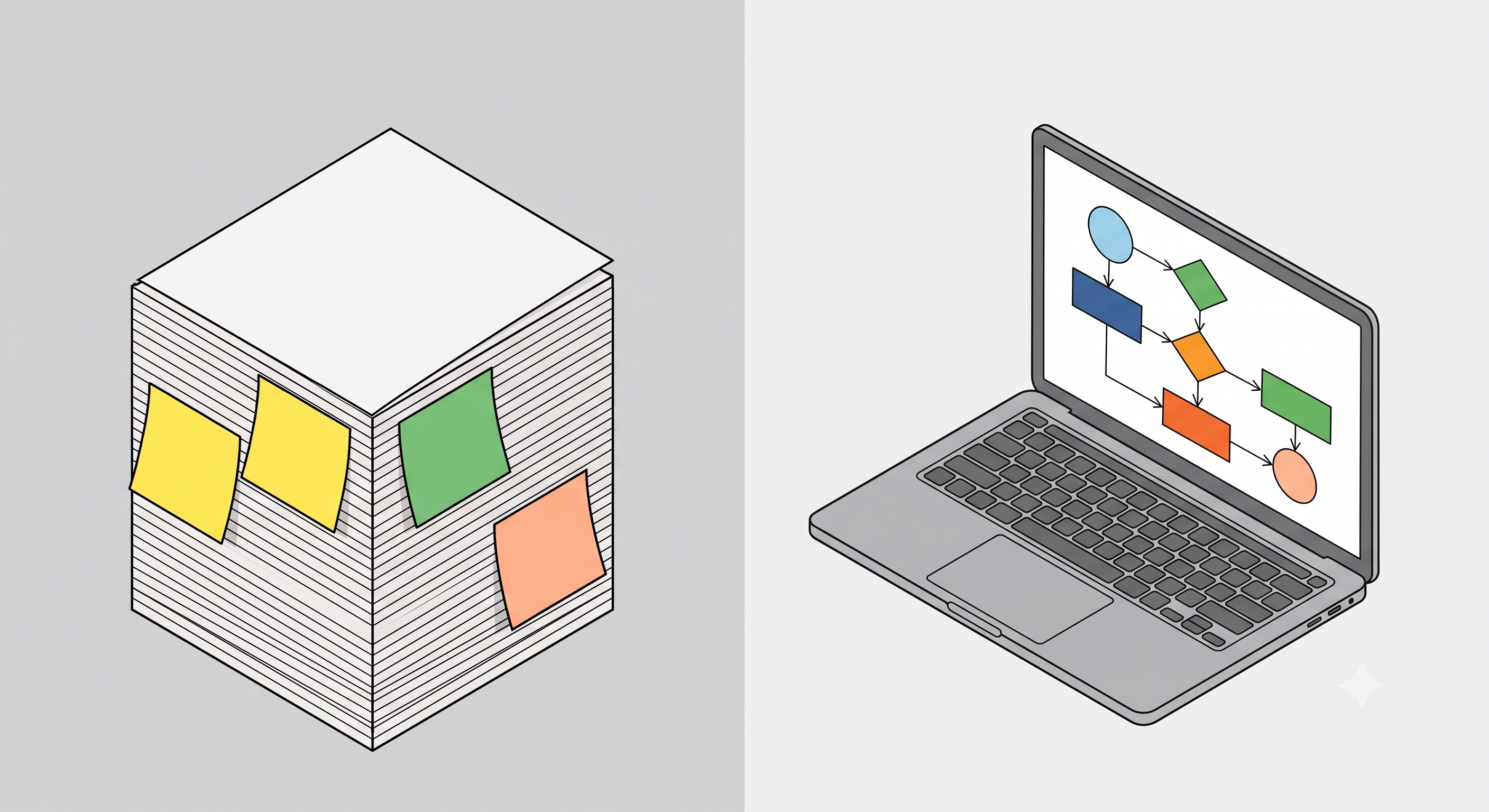
The Pixel-pushing bottleneck
Think of traffic during your morning commute. Or maybe your afternoon commute. Have you ever experienced a time when an accident occurred and three or four lanes of traffic on the freeway had to be shut down? Say goodbye to getting to work on time because that bottleneck isn’t letting you get anywhere fast.
Similar situations occur in higher education divisions. Leaders can be forced to manage rapid team restructures, shifting space allocations, and moving budgets. When these foundational shifts occur, the data supporting them often lives in static files. This is where the major bottleneck inefficiencies emerge:
-
Manual upkeep: Operational leaders frequently find themselves trapped adjusting shape sizes, aligning text boxes, and manually updating details for executive reviews. This manual work drains administrative bandwidth and distracts from mission-critical fundraising support.
-
Institutional isolation: Critical operational workflows—like onboarding, seat assignments, and cross-departmental purchasing—are hidden away in isolated network folders or dead PDFs. Cross-functional teams are left completely in the dark.
-
Software proliferation: Without centralized, interactive documentation, different departments end up buying overlapping, un-vetted software tools to solve immediate problems like interactive facility mapping, cluttering the campus tech stack.
Administrative efficiency (and team-wide bottlenecks) cannot improve with manual tools. As one operational leader put it:
“I spend an inordinate amount of time trying to deal with manual formatting...I would love to be able to say, 'Here’s all my info, and I want it to look like this.' Can someone please help me do that?”
Undam the bottleneck: Build an automated operational twin
To eliminate the burden of manual updates, advancement divisions must transition to automated, data-driven visuals. Establishing an interactive operational twin of the division’s personnel and physical footprint turns passive drawings into dynamic tools for strategic management.
Create a self-updating source of truth
Instead of hand-drawing hierarchies and floorplans, divisions can link their core rosters directly to data sources like Google Sheets or standard CSV formats.
Lock in institutional memory and transparent onboarding
Bringing hidden processes out of text-heavy manuals and into a visual directory creates clear paths for everyone. New-hire onboarding, desk transitions, and procurement workflows become immediately transparent. Operational knowledge is preserved as permanent institutional memory, rather than being trapped in a single administrator's local files.
Safe, compliant AI automation
Advancement teams want AI tools to ease their administrative burdens, but un-vetted generative platforms present severe data privacy and security risks. By standardizing on a secure, enterprise-vetted visual platform, leadership can let teams safely use native AI capabilities to instantly generate flowcharts, brainstorm operational models, and map workflows—all within institutional security guardrails.
The 3-phase roadmap to automation
Transitioning from a manual pixel-pusher model that causes all sorts of internal bottlenecks to an automated system champion doesn't happen overnight. Here is how advancement divisions can roll out this strategy in three clear, logical steps:
Phase 1: Establish the data foundation (quick wins)
-
The action: Stop drawing shapes manually. Connect your existing personnel rosters and spreadsheets directly to automated org chart and layout builders.
-
The payoff: Instantly eliminates manual alignment errors and hours of tedious formatting. When HR updates the roster, the visuals update themselves.
Phase 2: Kill the isolation (departmental alignment)
-
The action: Map out cross-departmental workflows visually (like desk transitions and procurement) and replace static PDFs with secure, live web-embedded links.
-
The payoff: Cuts operational friction during onboarding and facility tracking. Leadership and cross-functional teams always see the exact same, real-time data.
Phase 3: Accelerate with secure AI (future-proofing)
-
The action: Route administrative brainstorming, flowchart generation, and process logic through native, enterprise-approved AI tools.
-
The payoff: Satisfies your team's demand for modern AI tools while completely protecting sensitive donor and institutional data from public models.
By transforming static, fragmented charting habits into an automated, scalable repository, advancement leadership can eliminate operational bottlenecks, protect data privacy, and build an efficient framework geared for long-term growth. And who knows, getting the organizational bottlenecks ironed out just might mean heading out of the office a little early so you can avoid the traffic ones.

