Higher Ed
Enhance teaching and foster collaboration with tools that simplify lesson planning, improve student interaction, and integrate seamlessly into your existing systems.

Scaling IT demand management in healthcare networks
A lead for demand management at a premier research university and healthcare system is utilizing visual orchestration to bridge the gap between complex clinical requests and technical implementation. By transitioning from static documentation to centralized, high-fidelity workflow maps, the institution has established a single source of truth that aligns medical staff with IT governance standards.
Topics:

Bridging product design and project execution
A lead product manager at a national department for education is making use of visual orchestration to bridge the gap between high-fidelity design and agile project execution. The institution has established a single source of truth that aligns product, design, and business analysis teams during complex sprint planning and journey mapping.
Topics:
Scaling systems thinking and academic integrity with visual assessment
A senior lecturer at a leading UK university is pioneering a longitudinal visual literacy curriculum to replace traditional, text-heavy assessments with systems thinking. By embedding visual collaboration directly into the virtual learning environment, the institution is mitigating the risks of generative AI fabrication while equipping graduates with future-proof, non-linear problem-solving skills.
Topics:

Streamlining Public Service Design and Policy Mapping | Lucid
A senior service designer at a national department for education is utilizing visual orchestration to navigate complex policy landscapes and student service models. By transitioning from static research methods to a live, collaborative design ecosystem, the department has eliminated tool friction and accelerated the synthesis of abstract user research into actionable service prototypes.
Topics:

Bridging industrial design and technical engineering
A lead industrial designer at a premier public research institution is using visual orchestration to manage the complex intersection of physical product design and digital user experience. Consolidating abstract brainstorming with high-fidelity technical specifications on a single infinite canvas has allowed the project lead to replace static documentation with a living workspace that informs engineering sequences and CAD modeling.
Topics:
Preparing human resources for an AI-first future with system mapping
A human resources project lead at a prominent private research university is spearheading a comprehensive institutional house-cleaning initiative to standardize process documentation. Through transitioning from fragmented notes to multi-layered integration maps, the department is shoring up institutional knowledge to prepare for major AI implementations and enterprise-wide system updates.
Topics:

Optimizing IT vendor management and software rationalization
An IT vendor management leader at a prominent private research university is utilizing visual orchestration to architect a transparent procurement and software lifecycle ecosystem. By leveraging the TIME (tolerate, invest, migrate, eliminate) analysis framework within a digital workspace, the institution has successfully aligned vendor relationships with its cloud-first mission and significantly reduced software proliferation.
Topics:

Preserving institutional memory through visual governance
A lead preservation strategist at a prominent private university is transitioning from reactive, narrative-based planning to proactive visual governance. They are revitalizing legacy workflows and establishing standardized decision trees to consolidate preservation practices across multiple library units to ensure optimal resource allocation and long-term collection stability.
Topics:

Digitizing the analog whiteboard for university IT governance
A business relationship manager at a prominent private research institution is overcoming the limitations of digital-first environments by transitioning analog whiteboard methodologies into a structured collaborative framework. Through leveraging visual prioritization tools and facilitator controls, the department has replaced static spreadsheets with dynamic project roadmaps that maintain stakeholder focus and accelerate institutional decision-making.
Topics:
Creating interactive process artifacts for research administration
A business analyst at a prominent private research university is redefining institutional documentation by transforming static diagrams into interactive artifacts. By making use of layered navigation and high-fidelity mapping, the office of research has established a centralized portal that allows stakeholders to navigate complex workflows with the simplicity of a web interface.
Topics:
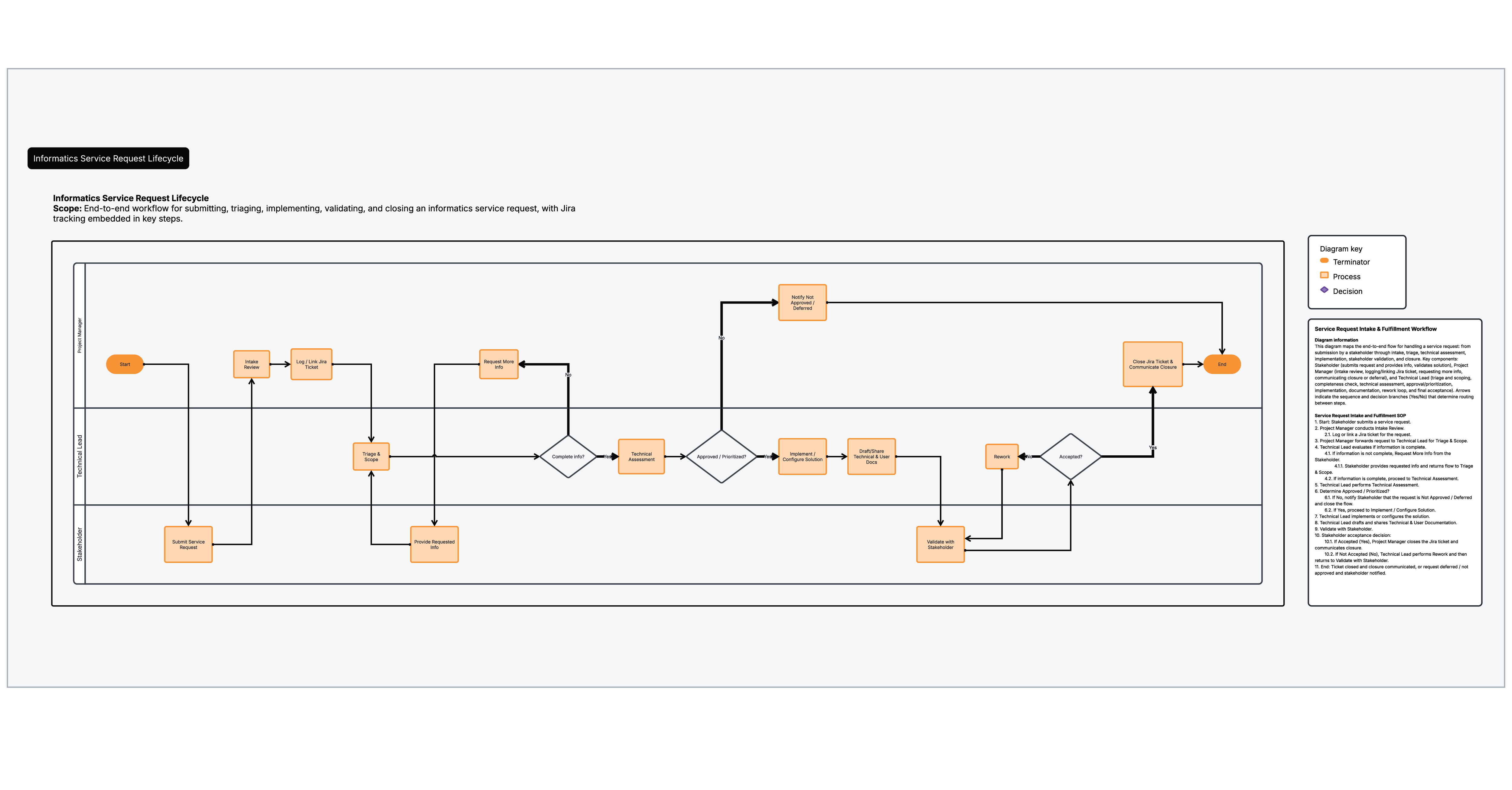
Streamlining biomedical research informatics with diagram as code
A biomedical informatics team at a premier clinical and translational science institute is transitioning from siloed open-source tools to an automated, enterprise-grade visual workspace. By adopting diagrams as code and bi-directional project management synchronization, the department has reduced technical documentation time from hours to minutes while establishing a living source of truth for complex research workflows.
Topics:

Bring your bright ideas to life.


By registering, you agree to our Terms of Service and you acknowledge that you have read and understand our Privacy Policy.